
Published January 8, 2026 03:07AM
In 1942, as desert warfare raged in North Africa, a crew of physiologists was dispatched to the Sonoran Desert to conduct experiments on soldiers. The goal was to figure out how much water they needed, how much heat they could take, and, if possible, “to train men to do without water.” As the lead scientist Edward Adolph later recounted in his classic 1947 book Physiology of Man in the Desert, this last goal was quickly shown to be hopeless: everyone, even hardened desert veterans, needs water.
Eighty years later, Adolph’s conclusions about the impossibility of adapting to dehydration are still the dominant view. But some doubts have emerged. In a new paper in the European Journal of Applied Physiology, Mark Funnell and colleagues from the universities of Leicester and Loughborough in Britain peer into their crystal ball to ask what’s next for dehydration research. One of their main predictions is that we’ll find that men and women respond differently to dehydration, with the latter potentially being more sensitive to it. The other, more controversial idea is that runners and other endurance athletes might be able to adapt to dehydration through repeated exposure.
The Gebrselassie Paradox
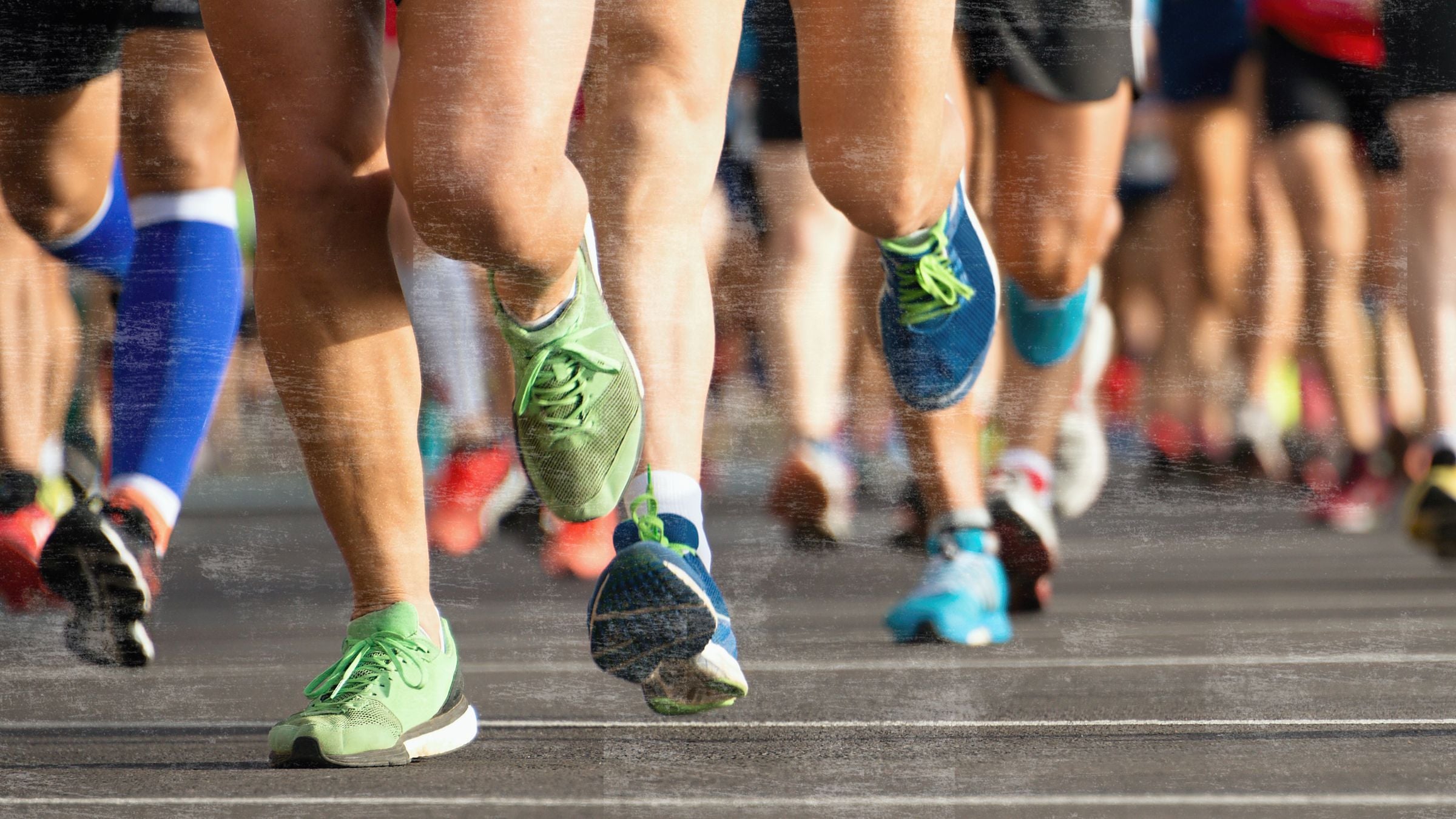
A key hint that it may be possible to adapt to dehydration comes from the apparent contradiction between lab studies and real-world performance by runners. Lab studies suggest that your performance will suffer as soon as you’ve lost two percent of your body weight, and perhaps even sooner. In the real world, the Ethiopian star Haile Gebrselassie once lost a whopping ten percent of his body weight while setting a marathon world record. Other studies of non-elite runners have found that faster runners tend to finish races more dehydrated than slower runners, contrary to the idea that dehydration slows you down.
One explanation for this apparent contradiction, advanced most notably by the South African scientist Tim Noakes, is that the studies are measuring the wrong thing. They impose an artificial form of dehydration, sometimes using heat chambers or diuretics, and prevent subjects from drinking when they want to, leaving them thirsty and irritated. In the real world, if subjects are allowed to drink when they’re thirsty, they still get dehydrated by more than two percent, but their performance doesn’t suffer.
Another possible explanation is that the subjects in laboratory dehydration studies are different from Gebrselassie and other marathon runners—perhaps because the runners have gotten used to dealing with being dehydrated.
How We Might Adapt
There are a few different problems that arise when you get dehydrated. One is that your blood volume decreases. During exercise, you need that blood to carry heat to skin to cool yourself down, and also to carry oxygen to your muscles. As blood volume decreases, you can’t do both, so your body temperature starts to creep upward.
Can you adapt to fight that process? Back in the 1980s, U.S. Army researchers published some data suggesting that exposure to dehydration might boost the level of proteins circulating the blood, which in turn (through some complicated physiology) would help move fluid from other areas of the body into your bloodstream to maintain higher blood volume next time you get dehydrated. That idea has never been confirmed, but it’s an example of the kind of physiological response that could conceivably occur over time to protect you from dehydration.
The other main problem with getting dehydrated is that it makes you feel thirsty, tired, and generally irritated, all of which hurt performance. To critics like Noakes, it’s these perceptual responses that are the real problem with dehydration—and it’s not hard to imagine that getting used to the feeling of being thirsty and/or dehydrated would eventually reduce its impact on your performance.
A couple of semi-recent studies have explored this idea. A 2014 study put subjects through four one-hour dehydration runs to get them used to the feeling of dehydration. After this adaptation protocol, their performance in a 5K time trial while dehydrated got significantly better. Notably, the improvement seemed to be linked to a decrease in their subjective perception of effort while dehydrated. On the other hand, a more recent 2021 study found no benefit from four weeks of running while dehydrated three times a week.
Why Runners Are Different
Given the mixed findings so far, Funnell and his colleagues unsurprisingly call for more research. We can all imagine what a perfect study might look like: a huge number of people randomized to spend weeks or months training exclusively while either fully hydrated or dehydrated to various degrees. Realistically, that’s a pipe dream. Instead, Funnell suggests starting with a cross-sectional study comparing athletes who habitually drink during training to those who don’t, to see if the former group is less affected by dehydration.
There are a few reasons to think that runners might be a good study group, even compared to other endurance athletes like cyclists. One is that the up-and-down motion of running makes drinking more difficult and harder on the stomach. Combine this with the fact that it’s harder to tote water bottles with you on a run than it is on a bike, and it’s not surprising that studies find that runners tend to drink less than cyclists (and often not at all).
There’s also a more subtle point: since you have to support your own body weight while running, the benefits of getting lighter are more pronounced. When someone like Haile Gebrselassie loses 12 pounds during a marathon, his running economy—the amount of energy burned to maintain a given pace—is steadily improving. This is an approach that carries plenty of risks, but it might be one of the reasons runners can get away with levels of dehydration that seem catastrophic in lab studies, which typically involve stationary bikes.
All of this suggests a potentially interesting comparison: are runners, who likely spend more of their training time in a dehydrated state, less affected by dehydration than cyclists? It seems like a fun question to study.
In the meantime, though, a note of caution. Debates about dehydration can be pretty polarized: some people think it’s a terrible scourge, others think it’s all a Gatorade-funded hoax. My take is somewhere in the middle. There are some situations where it probably pays to follow a pre-planned hydration strategy, like when you’re running a marathon in hot conditions. If Funnell and his colleagues are right, there may be other situations where it’s useful to deliberately let yourself get dehydrated. But in the vast, vast majority of cases, I suspect your best bet is to drink when you’re thirsty, and don’t worry about it when you’re not.
For more Sweat Science, sign up for the email newsletter and check out my new book The Explorer’s Gene: Why We Seek Big Challenges, New Flavors, and the Blank Spots on the Map.
Source link