Published May 6, 2026 09:17AM
It’s well-established that women are better at pacing marathons than men are—that is, they’re less likely to go out too fast and then slow down dramatically in the second half of the race. By “well-established,” I mean that there are numerous scientific papers analyzing real-world marathon results that come to this conclusion, and plenty of press coverage spreading this message to the general public.
That makes a new study in the Journal of Sports Sciences surprising in a dog-bites-man kind of way. It’s a reanalysis of exactly the same data used in a major 2015 study that is considered one of the most convincing demonstrations of the women-pace-better-than-men phenomenon. The new study doesn’t claim to prove that sex differences in pacing don’t exist, but it argues that the picture is considerably more nuanced than the scientific literature and press coverage suggest; that the way these big sets of real-world marathon results have been analyzed is prone to misinterpretation; and that the resulting broad assumptions about supposedly innate differences between men and women are misleading.
The authors of the new study are Matthew Tenan and David Borg. Tenan’s affiliation is listed as the Rockefeller Neuroscience Institute in West Virginia, but he has since moved on to a position as “Real World Data Scientist”—a position title that’s relevant here, as you’ll see—with Eli Lilly. Borg is a sports scientist with the Australian Institute of Sport and Queensland University of Technology, whose work on quality problems in sports science research I’ve written about previously.
The Original Claim
The lead author of the 2015 study was Robert Deaner, an evolutionary psychologist at Grand Valley State University. Over the years, Deaner has published a number of studies suggesting that men and women pace themselves differently, arguing that men tend to be more competitive and are more likely to take risks with an aggressive early pace. This difference, he argued in an article in The Conversation, “reflects, at least in part, innate predispositions that evolved in response to the different challenges men and women faced during our evolutionary history.”
Deaner and his colleagues assembled finishing data and splits from 91,929 runners at 14 marathons in the United States in 2011. Overall, men ran the second half of their marathons 15.6 percent slower than the first half; women, in contrast, slowed by only 11.7 percent. Women were 46 percent more likely than men to slow by less than ten percent, and 64 percent less likely to slow by more than 30 percent.
The study slices and dices the data in various ways, for example, by dividing the subjects into groups based on half-hour finishing time increments: 3:00 to 3:30, 3:30 to 4:00, and so on. They adjust the boundaries of these categories by 12 percent in order to compare men and women. The underlying assumption here is that a 3:00 marathon for men is roughly equivalent to a 3:22 marathon for women, due to biological differences in characteristics such as VO2 max, muscle mass, and red blood cell concentration. If you directly compare male and female 3:00 runners, the female runner is at a higher level, meaning she probably trains harder and has more experience, which may translate into better pacing.
This more detailed analysis suggests that the biggest second-half slowdown occurs in slower runners, particularly if they’re male. But, they emphasize, “the sex difference in pacing occurred across age and finishing group times.” And it’s a big difference, in their telling: faster men slowed down by 25 percent more than faster women, and slower men slowed down 30 percent more.
The Revised Take
Tenan and Borg are interested in “real-world data,” a huge category that basically refers to information that isn’t collected in traditional lab experiments. It’s an important source of data in medicine and drug approvals, hence Tenan’s position with Eli Lilly, and also a largely untapped source of data in sports. But it’s got problems. If you don’t handle it carefully, watching out for sources of bias or error and analyzing it with appropriate techniques, your conclusions may be incorrect.
With that in mind, Tenan and Borg reanalyze Deaner’s raw data—which he provided to them—in an attempt to reproduce the results, check the validity of the assumptions, and perform their own analysis using different techniques to see if it reaches the same conclusions.
They find some minor quirks in the data: a one-year-old who purportedly ran a 3:51 marathon, as well as ten 99-year-olds. These are obviously examples of bad data, but given the enormous size of the dataset they don’t skew the results in any meaningful way. The more serious concerns get into the weeds of appropriate statistical methods: the ways in which the raw data deviates from a normal bell-shaped distribution, the decision to lump together finishers in half-hour brackets, and the 12 percent adjustment for women’s times. All of these factors, they argue, have the potential to produce erroneous conclusions.
So what do they come up with instead? Their own analysis, using a different statistical approach to address these shortcomings, finds that “there are some potentially interesting differences in pacing between genders, but the differences are only evident in younger and slower runners.”
Here’s what that looks like for pacing difference as a function of how much runners slowed down in the second half:
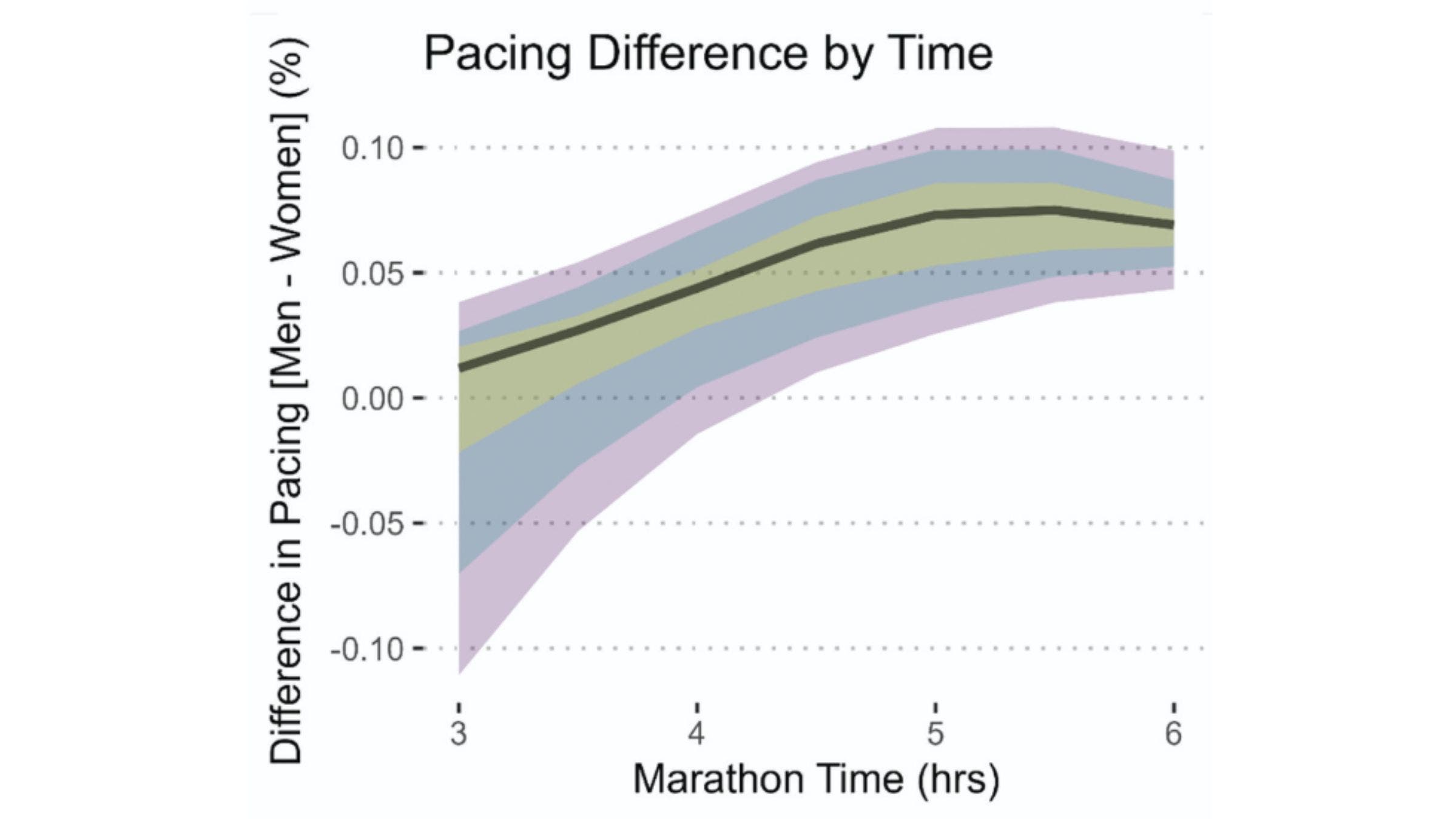
The vertical axis here shows the difference between how much men slowed down and how much women slowed down. On the left side of the graph, for three-hour marathoners, the difference is almost zero, meaning that both sexes were equally “good” at pacing. On the right side of the graph, the difference grows: for five-hour marathoners, men slowed by about seven percentage points more than women.
Here’s a similar graph for pacing differences as a function of age:

In this case, the difference between men and women is most pronounced for younger runners, and disappears for older runners.
The Takeaway
Tenan and Borg’s reanalysis doesn’t produce any dramatic gotcha moment. If the basic claim is that men and women, on average, tend to have slightly different pacing patterns in marathons, the data still bear that out. But how strong is this claim? And how universal are the differences? Deaner’s paper characterizes the differences as “robust,” persisting across age and finishing times, and likely reflecting sex differences in physiology and/or decision-making.
The reanalysis, on the other hand, uses the same data to show that these differences also depend on age and finishing time. If that’s the case, Tenan and Borg argue, it’s more likely that the pacing patterns reflect “a social difference” rather than some fundamental biological or evolutionary truth. Moreover, claiming that men slow by 25 percent more than women overstates the size of the effect. Among three-hour finishers, men slowed by 6.9 percent and equivalent women by 5.5 percent: strictly speaking, that’s a 25-percent difference, but Tenan and Borg argue that it would be more accurately expressed as a 1.4 percentage-point difference.
Ultimately, no database of race results, no matter how large, can tell us what causes pacing differences. Deaner, to his credit, has tried to flesh out his argument by studying sex differences in competitiveness in other activities like video games, and by exploring how traits like risk-taking influence the likelihood of hitting the wall in marathons. The main takeaway for me, though, is that the simple picture of men pacing marathons like idiots is too simple, despite the pile of similar studies reporting similar results using similar methods. Real-world data is complex; we shouldn’t expect it to give us simple answers.
I also can’t help thinking of Sabastian Sawe’s history-making sub-two-hour marathon last weekend, achieved—just like the previous world record that he broke—with a substantial acceleration in the second half. Evolutionary history, no matter how deeply wired it may or may not be, is no excuse for bad pacing.
For more Sweat Science, sign up for the email newsletter and check out my new book The Explorer’s Gene: Why We Seek Big Challenges, New Flavors, and the Blank Spots on the Map.
Source link