Published December 24, 2025 07:55PM
Maybe your knee twinges every time you sink into a squat. Or the joint feels off when you’re doing step-ups. Maybe you just can’t seem to lunge without experiencing some knee discomfort. Simply put, you have knee pain with exercise—and it’s getting in the way of your workouts.
The logical next step might seem obvious: stop doing whatever motions are causing your irritation. But in many cases, that’s actually not the best approach, says Dan Ginader, a physical therapist in New York City and author of the stretch and exercise book, The Pain-Free Body.
“You never want to fall into the pattern of just avoiding movements altogether, because to live our lives to their fullest potential, we need to be able to do all kinds of things,” he explains. “And therefore, you want to be strong and resilient and flexible in different ways.” This type of well-rounded fitness is built by doing a wide variety of motions—not swearing certain ones off.
As Laura Sommer, a physical therapist and owner of the sports medicine physical therapy practice In Motion Physical Therapy based in Farmingdale, New York, puts it: “The only way you are going to get stronger is if you actually use the muscles and the joint.” She caveats that in some situations, rest is good—such as in the case of an acute injury or severe pain. But in general, resting all the time and avoiding exercises indefinitely just decreases your body’s capacity for that movement.
What’s more, avoiding exercise can actually increase inflammation and speed up the progression of arthritis, Sommer adds. In other words, it can worsen knee pain.
A better bet, Ginader and Sommer say, is modifying exercises so that you can do them sans pain. We asked these experts exactly how to amend popular moves so they’re gentler on your knees, why some exercises can exacerbate knee pain in the first place, and the red flags that warrant a visit to your doctor or physical therapist.
Why Some Exercises Trigger Knee Pain
A common culprit of knee pain is tight, overworked quads. Because the quads connect to the knee, this can lead to pain directly over the kneecap, Ginader explains. So when people are already experiencing this type of knee pain, doing quad-dominant exercises—like a forward lunge, step-down, or squat—can place even more stress on the knee and exacerbate symptoms.
In other cases, having mobility restrictions in certain areas, such as the ankles or hips, can inhibit the knee from moving the way it’s supposed to in a given exercise, Ginader says. In turn, that can cause the joint to take on extra stress, triggering pain and discomfort.
Importantly, “these activities themselves are not the cause of the pain,” Ginader says. They highlight an underlying condition, muscle weakness, or mobility restriction that needs to be addressed to resolve your knee pain fully. In the meantime, though, modifications can serve as a helpful bridge to keep you moving.
How to Modify 6 Popular Exercises to Reduce Knee Pain
These modifications can serve as a helpful bridge to keep you moving and keep knee pain at bay.
1. Lunges
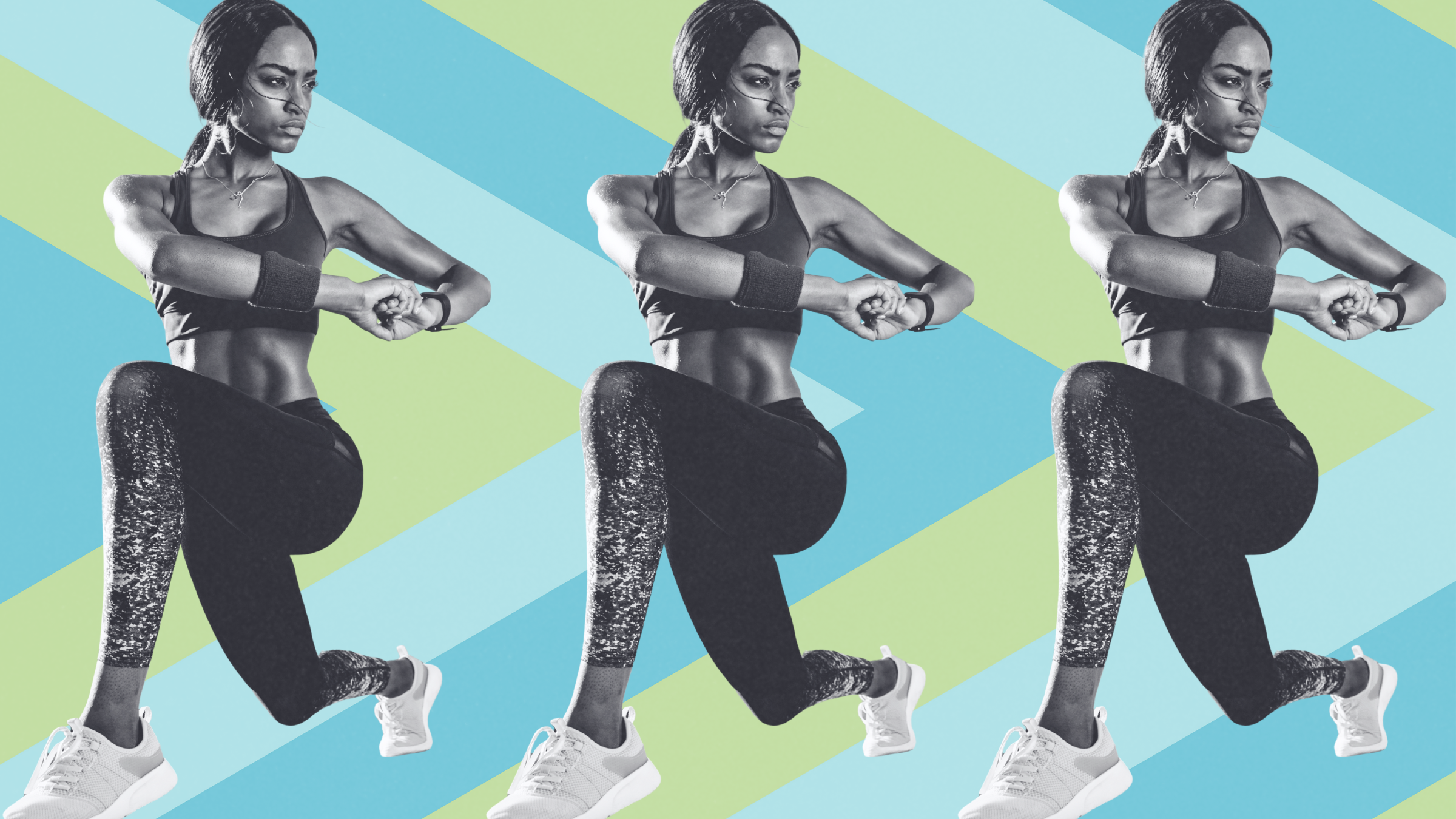
In Ginader’s experience, lunges are the “number one” exercise that exacerbates people’s knee pain. And that’s because most people do forward lunges (where you start with both feet together and then step one out in front), which emphasizes the quads, rather than the glutes and hamstrings. Beyond that, lunges are a single-leg move, which makes them “inherently a little bit tougher to handle and more unsteady,” he says. This added difficulty can increase people’s chances of performing the move with form errors, which can worsen knee pain.
Modification 1: Reverse Lunges
Try a reverse lunge, which takes some emphasis off the quads by spotlighting the glutes and hamstrings instead, Sommer says. It’s also slightly less of a balance challenge.
How to Do It:
- Start with both feet together, hip-distance apart.
- Step one foot behind you.
- Bend both knees to 90 degrees to lower down in the lunge.
- Press through your front heel to return to standing.
Modification 2: Split Squats
If the reverse lunge still triggers knee pain, Sommer suggests trying a split squat.
How to Do It:
- Stand with one foot several feet in front of the other, feet hip-distance apart.
- Bend both knees to 90 degrees to sink into the lunge.
- Press through your front heel to return to standing.
Compared to a traditional forward or reverse lunge, where you’re lifting one leg off the ground and taking a step forward or backward with each rep, this variation keeps both feet on the ground the whole time, which makes it less of a balance challenge and thus friendlier for your knees.
If the split squat fails to alleviate your pain, decrease the depth of your lunge, Sommer says. For example, instead of lowering down far enough that both your legs form 90-degree angles, stop several inches above that point. “If we don’t bend our knees as much, we’re not going to have quite as much pain and discomfort,” she explains.
2. Squats
Squats are similar to lunges in that you can perform them in a way that really biases the quads and thus flares up knee pain.
Modification 1: Reduce the Depth of Your Squat
Instead of sinking until your thighs are parallel with the ground, pause several inches before that point. This will reduce the amount of knee flexion you do, which can reduce the stress on the joint.
Modification 2: Use a Lighter Weight If You’re Doing Weighted Squats
If you do weighted squats, drop the weight, Ginader says. This will make the exercise less taxing on your entire body–including your knees. Or, incorporate more of your upper body into the routine by holding onto suspension straps or an elevated surface (like the back of a chair or sofa) as you complete your reps, Sommer says. This will reduce the strain on your knees (and the lower half in general) because your arms are taking on some of the work.
Modification 3: Shift Your Weight to Your Heels
Alternatively, shift your weight into your heels as you perform the movement, Ginader adds. This will help activate your backside muscles, especially the glutes, and reduce the workload on your quads.
Modification 4: Use a Resistance Band
Another, related mod is to place a looped resistance band around your knees, Ginader says. Focus on pushing your knees out against the band as you squat. This can also work to increase glute activation and ultimately decrease strain on the knee.
3. Step-Ups
Step-ups are another exercise that can easily emphasize the quads, especially when you shift your weight forward. If your quads are already overworked and tight, that can certainly contribute to knee pain.
Modification 1: Keep Your Weight On Your Heels
Make the exercise more glute-focused by keeping your weight in your heels, Ginader says. You can also reduce the height of your step, Sommer adds. For example, swap your eight-inch bench for one that’s six, four, or even just two inches high. “The lower the height of the step is, the easier it’s going to be on our joints, because we don’t have to bend our knee as much to get into that position,” she explains.
Modification 2: Lateral Step-Up
If that’s still painful, try a lateral step-up, Sommer suggests. Instead of stepping forward to come onto the bench, step up from the side. This variation increases glute engagement and thus diminishes how much your quads have to work, which in turn decreases strain placed on the front part of the knee, she explains.
4. Descending Stairs
Walking down the stairs “can be pretty painful” for some people’s knees, especially if they have weak quads, Sommer says. That’s because when the quads aren’t doing their job of controlling your motion down the stairs, the knee joint can take on some of that stress.
Modification 1: Steady Yourself By Placing Your Hand on a Wall
As you descend, place your hand on the railing or wall. “Using that upper body support is going to help decrease the stress that we’re putting through our knee,” Sommer says.
Modification 2: Go Down the Steps Sideways
Another option is to go down sideways, leading with your non-painful side. Similar to the step-down modification, this lateral approach recruits more of your glutes to support the motion while reducing strain on the quads and knees.
5. Walking on Uneven Surfaces
Strolling on unstable surfaces, such as the beach or rugged terrain, requires greater strength and stability from the muscles in your feet and ankles. “If we’re not super strong there, the next joint that starts to take over is our knee joint,” Sommer says. “If we’re using all those stabilizer muscles around our knee a lot more, it puts more strain on the joint.”
Modification 1: Invest in a Good Sneaker
Wearing a sneaker that offers good stability can help support the feet and ankles, and by extension the knees, Sommer says. (Here are some great shoes built for use on uneven terrain.)
Modification 2: Use Trekking Poles
Using a walking stick, trekking poles (like these), or holding onto a railing (if available) can also help by recruiting your upper body to pitch in, thereby reducing the stress on your knees.
6. Hiking
This one is very similar to stairs and walking on uneven surfaces. When you’re traversing rocky terrain, “you really need to control yourself so you don’t go toppling down with gravity,” Sommer says. This places a lot of strain on your quad muscles, particularly on downhill sections, and when they become overtaxed, your knees may pay the price.
Modification: Bring Trekking Poles
Bring a walking stick or hiking poles to help reduce the balance challenge and encourage your upper-body muscles to take on some of the stress your knees may otherwise field, Sommer says.
Also, make sure you pace yourself and take regular breaks so your quads don’t get overly fatigued, she adds.
When to See a Doctor About Knee Pain Related to Exercise
If you’ve taken steps to address your knee pain, for example, you’ve modified your exercises, or tried targeted stretches—and it persists pretty consistently after ten to 14 days, “it’s time to go in and see someone,” Ginader says. The same goes if your pain is getting worse, Sommer adds.
Also, if your pain is sharp and stabbing, if your knee swells after exercise, or if your knee started hurting as the result of an acute injury (for example, you missed a step coming down the stairs and now your joint is throbbing, feels unstable, and/or is clicking repeatedly as you move it), you should get help ASAP. “Those are definitely instances where I would say you need some more dedicated medical support, rather than trying to just exercise your way through it,” Sommer says.
Modifications Should Be a Short-Term Solution
A final caveat with all this: “Modifications can be good to keep you moving, but at the end of the day, you should also be taking steps to address the root cause” of your knee pain, Ginader says.
For many people, that involves strengthening their weak quads. On that front, Ginader recommends using the knee extension machine at the gym, which is a super-effective, research-backed way to strengthen your quads. Work one leg at a time, fully straightening out the knee and holding at the top for 40 seconds. Repeat for ten total reps.
If you don’t have access to that machine, use eight to ten-pound ankle weights, sit on the couch or in a chair, and fully straighten out one knee at a time. Again, hold that quad contraction for 40 seconds, then repeat for ten total reps. Do this twice a week, Ginader suggests.
Beyond that, find areas where you’re tight and regularly stretch, massage, or foam roll them, Ginader says. This can reduce tension and boost blood flow, helping you heal from any injuries that may be contributing to your cranky knees.
Want more Outside health stories? Sign up for the Bodywork newsletter. Ready to push yourself? Enter MapMyRun’s You vs. the Year 2025 running challenge.